For the next week we will be doing an in-depth survey of the cluster known as Caldwell 14. Discovering, mapping, and bio-scanning anything we can find in there, and logging it to our discoveries spreadsheet for the leg, which can be found: here
Dates
Start Date: January 14, 2023 End Date: February 4, 2023
The optional waypoints for this leg is to simply scout out any stars you can within the cluster. There is a shared discoveries spreadsheet available at this link: https://theexpedition.info/Caldwell1 to keep track of what has already been scouted by the group and what needs to be scouted still. Please make sure to record any progress there as well!
For the next three weeks we will be doing an in-depth survey of the cluster known as Caldwell 1. Discovering, mapping, and bio-scanning anything we can find in there, and logging it to our discoveries spreadsheet for the leg, which can be found: here
Dates
Start Date: January 14, 2023 End Date: February 4, 2023
Map References quick reference list, more details below
NGC 188 SMV 4385
Main Waypoints Details
Map Reference: NGC 188 SMV 4385
POI: Caldwell 1
Caldwell 1, also known as NGC 188 is an open cluster located within the Cepheus constellation areas of the sky as seen from Earth. Being circumpolar as well it is always above the Horizon no matter where you are in the northern hemisphere. It was discovered in 1831 by John Herschel. Among open clusters it has a high number of main sequence stars making it of particular interest to scientists studying those and for potential exoplanets.
It is the first object in the Caldwell catalog made by Sir Patrick Alfred Caldwell-Moore to act as a complement to the Messier catalog. The objects in the Caldwell catalog are ordered by their declination, meaning Caldwell 1 is the most northerly in the sky, and Caldwell 109 being the most southerly.
The optional waypoints for this leg is to simply scout out any stars you can within the cluster. There is a shared discoveries spreadsheet available at this link: https://1drv.ms/x/s!AuaQ1lvTHzu7jkpyRmG-FXzQ2uvU?e=dE7SG0 to keep track of what has already been scouted by the group and what needs to be scouted still. Please make sure to record any progress there as well!
We are setting off with the first leg of the fifth Celebration of Early Astronomy. In this leg we are travelling from the human populated bubble up to our entry basecamp for Caldwell 1, which we will then enter on leg 2 and spend three weeks scouting in depth.
Dates
Start Date: January 07, 2023 End Date: January 14, 2023
Distances
Basecamp Line: 6,461.95 Ly Main Waypoints: 8,219.67 Ly
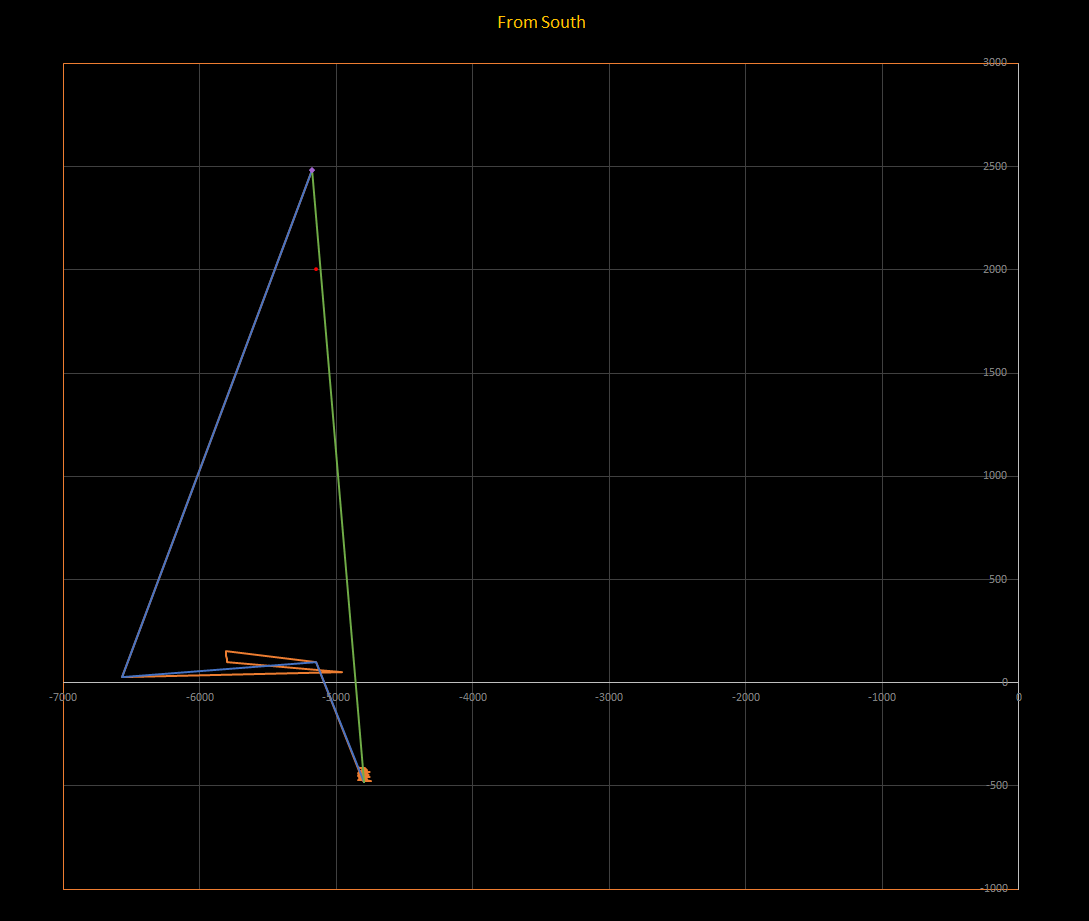
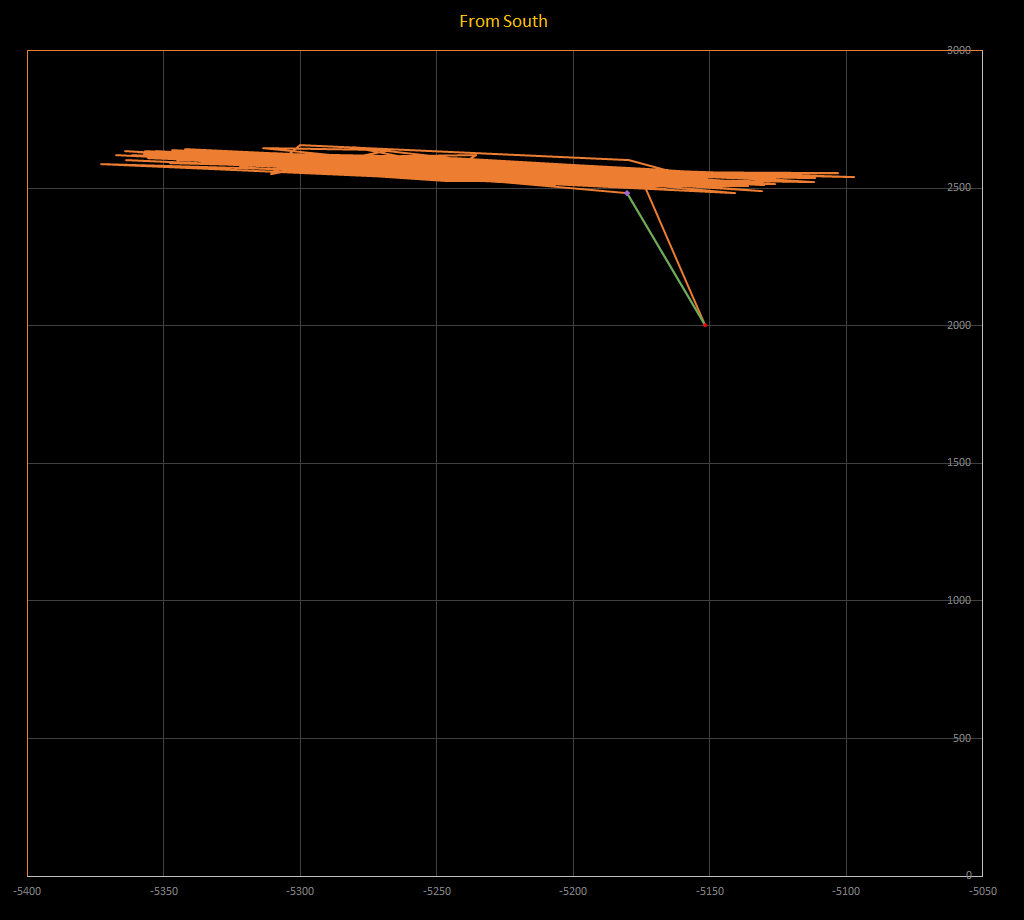
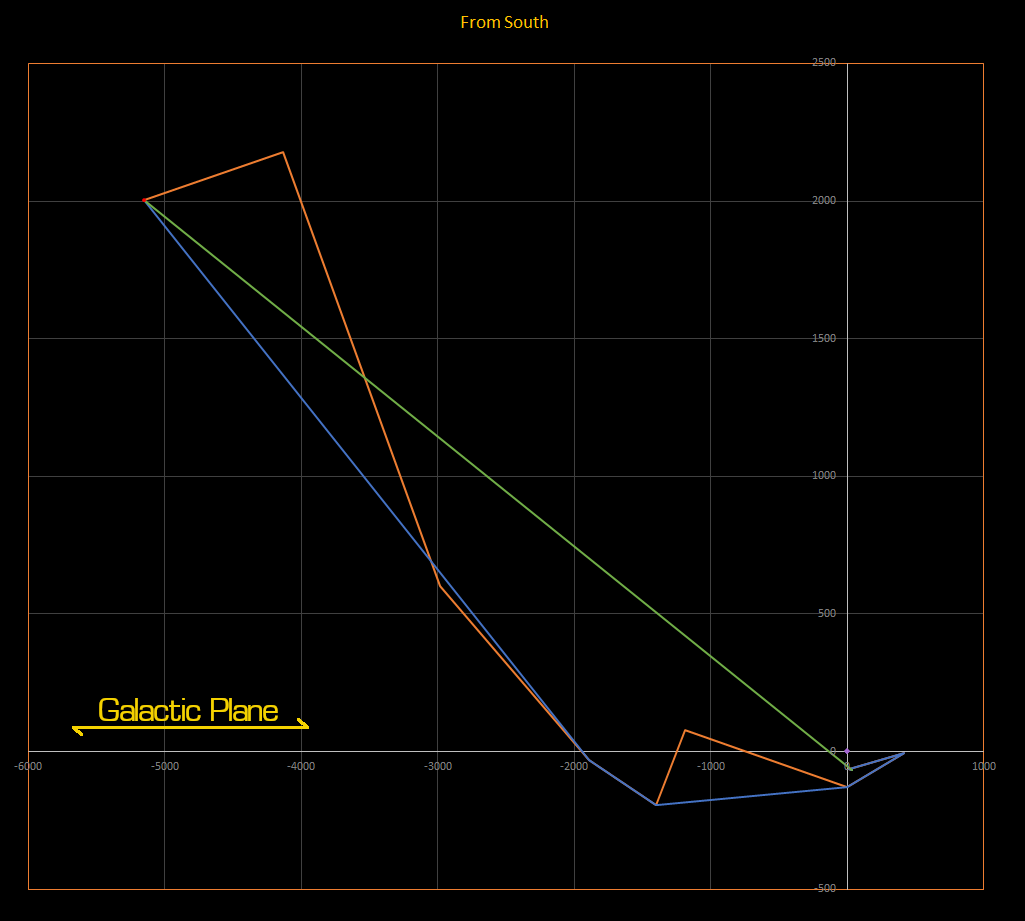
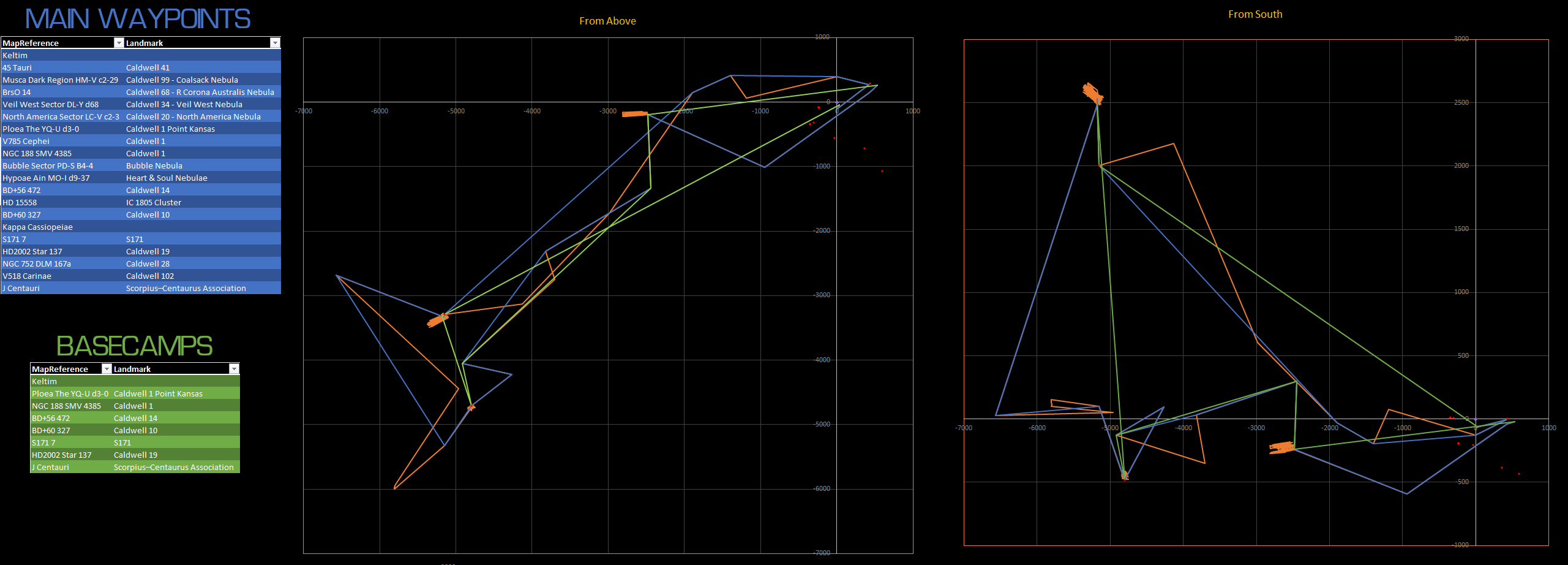
Map, (click for full size):
Basecamp: Ploea The YQ-U d3-0
Main Waypoints
Map References quick reference list, more details below
Keltim
45 Tauri
Musca Dark Region HM-V c2-29
BrSO 14
Veil West Sector DL-Y d68
North America Sector LC-V c2-3
Ploea The YQ-U d3-0
Main Waypoints Details
Map Reference: Keltim
POI: GJ 149
We will launch our fifth Celebration of Early Astronomy Expedition from this location
Caldwell 41, The Hyades Cluster is the nearest open cluster to our own solar system, and one of the best studied star clusters in existence due to that. From the perspective of Earth, it appears within the constellation Taurus at a similar angle in the sky to Aldebaran, albeit unrelated to Aldebaran otherwise. Four stars of the Hyades, with Tauri constellation Bayer designations Gamma, Delta 1, Epsilon, and Theta form the asterism that is the head of Taurus the Bull. Due to its proximity to our own solar system, the distance to it can be measured using parallax shift of the member stars as we orbit our own sun throughout our year. This leads to the a highly accurate mesaurement of roughly 145 Ly to the center of the cluster. 45 Tauri particularly is on the closer side of the cluster.
Caldwell 99, The Coalsack Nebula is a dark nebula easily visible to the naked eye in the sky as a dark patch obscuring part of the Milky Way’s band. Taking up about 7 degrees of arc in the night sky it is multiple times the size of the apparently size of the moon in our night sky from Earth. In Australian Aboriginal astronomy, it forms the head of the “Emu in the Sky” constellation. It was likewise a bird in Incan astronomy as well, representing a Tinamou.
Caldwell 68, roughly 400 lightyears away from our solar system is one of the nearest star-forming regions to us. It is one part of the larger Corona Australis Molecular Cloud. It was discovered in 1861 by Johann Friedrich Julius Schmidt. It is a variable nebula which shows irregular variations in brightness and shape.
Caldwell 34, also designated as NGC 6960, a nebula in the Cygnus constellation and constitutes the visible portions of the Cygnus Loop. It is the remnants of a supernova. It is also sometimes referred to as the Cirrus Nebula or the Filamentary Nebula.
Additional viewing site suggestion: Veil West Sector PD-S B4-2, puts it nearly in line with Barnard’s Loop for a spectacular view.
Caldwell 20 was discovered by William Herschel in 1786 and located roughly 1800 lightyears from our own solar system it occupies a section of the sky roughly three times the apparent size of a full moon within the constellation Cygnus. It is an emission nebula with the clouds of gas being ionized by a nearby star, causing the gas to glow. The reddish colour is characteristic of hydrogen the dominates Caldwell 20.
Caldwell 2 was discovered by William Herschel in 1788 and located roughly 3500 lightyears from our own solar system in the constellation Cepheus. It can be quite difficult to spot due to having only apparently visual magnitude of 12.3, making it the faintest object in the Caldwell catalog.
“The early 2000s, they were often the speculative setting of early science fiction works. Early imaginings of interstellar travel, first contact with aliens, apocalypses, pandemics, you name it, there was probably a movie or book set in the early 21st century of it. While humanity may not have invented interstellar travel by 2020 as many novels and films purported, they still discovered plenty gems of our galaxy by then.
Lucky for us in 3308 we do have interstellar travel and can visit these gems that humans on Earth in the early 21st century could only dream of visiting. So that is just what we will be setting out to do. This expedition will visit many of the noteworthy celestial objects discovered by the early 21st century, some of which even still are considered noteworthy even today in 3308.
We will be setting off from our faction’s home system Keltim, also known as Gliese 149 to the humans of 2020. From there we will be travelling our route clockwise. Many of the sights on this expedition revisit those featured on earlier CEA expeditions for those that weren’t on those.
Please fill out a sign-up form if you’re coming along! Note: even if you’re not sure yet all your details, the form will give you an edit link once you submit so that you can come back and edit your submission in the future with any changes you make. Just make sure to save your link!
For Celebration of Early Astronomy 5 we are focusing on exploring various Caldwell clusters, and in particular, Caldwell 1, a large cluster high up from the galactic plane that can only be entered and exited using a carrier. The Caldwell catalog was created by Sir Patrick Alfred Caldwell-Moore, a British astronomer and influential TV presenter on the topic of astronomy.
All legs will be one week long with the exception of our week in Caldwell 1, which will be three weeks long in duration. During this time there will be a pair of carriers swapping positions daily
===================== Current Waypoint List =====================
Leg 1 – 1/7 – 1-14
Keltim (GL 149)
45 Tauri (Caldwell 41)
Musca Dark Region HM-V c2-29 (Caldwell 99 – Coalsack Nebula)
BrSO 14 (Caldwell 68 – R Corona Australis Nebula)
Veil West Sector DL-Y d68 (Caldwell 34 – Veil West Nebula)
North America Sector LC-V c2-3 (Caldwell 20 – North America Nebula)
Ploea The YQ-U d3-0 (Caldwell 1’s pre-entry point)
Leg 2 – 1/14 – 2/4
V785 Cephei (Caldwell 1)
NGC 188 SMV 4385 (Caldwell 1)
Leg 3 – 2/4 – 2/11
Bubble Sector PD-S B4-4 (Bubble Nebula)
Hypoae Ain MO-I d9-37 (Heart & Soul Nebulae)
BD+56 472 (Caldwell 14)
Leg 4 – 2/11 – 2/18
HD 15558 (IC 1805 Cluster)
BD+60 327 (Caldwell 10)
Leg 5 – 2/18 – 2/25
Kappa Cassiopeiae
NGC 457 124 (Caldwell 13)
S171 1 ([GMM2009] S171)
Leg 6 – 2/25 – 3/4
HD2002 Star 137 (Caldwell 19)
Leg 7 – 3/4 – 3/11
NGC 752 DLM 167a (Caldwell 28)
V518 Carinae (Caldwell 102)
J Centauri (Scorpius-Centaurus Association)
=====================
Each Leg will additionally have an announcement post when they start detailing any optional waypoints they may have added to them. Optional waypoints are subject to be added during the expedition up until the start of the leg.
For the “At the Eldritch Gate” expedition, Celebration of Early Astronomy will be basecamping at the Dehe PP-V d3-22 system. Here is a list of some real celestial objects of interest near the line between LAWD 26 and Dehe PP-V d3-22.
Dates
Start Date: July 10, 2022 End Date: September 10, 2022
Distances
Basecamp Line: 21,447 Ly Main Waypoints: 24,289 Ly
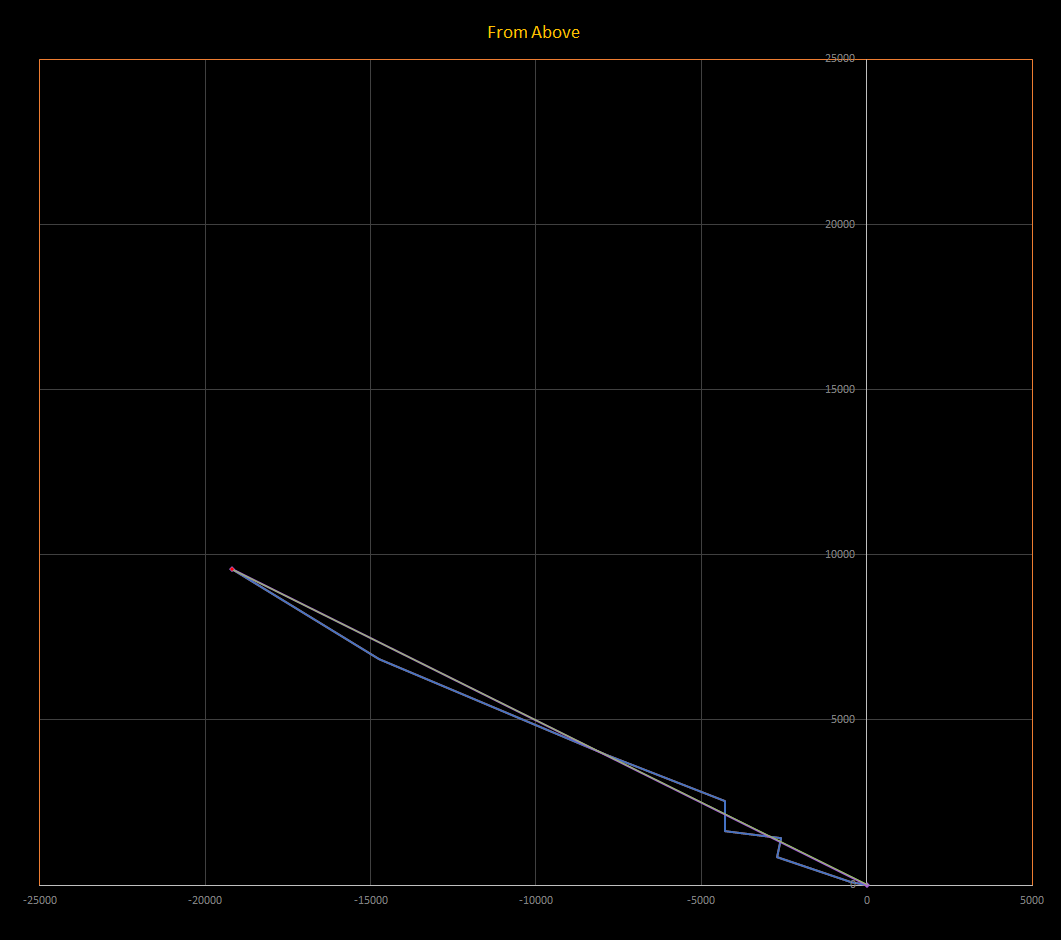
Map, (click for full size):
Basecamp: Dehe PP-V d3-22
Points of Interest
Map References quick reference list, more details below
LAWD 26
Kepler-186
Kepler-7
CSI+19-20201
KOI 3901
PSR J1959+2048
QZ Vulpeculae
Campbell’s Hydrogen Star
Dehe PP-V d3-22
Points of Interest Details
Map Reference: LAWD 26
This is where the “At the Eldritch Gate” expedition will be launching from
The first Earth-sized exoplanet to be discovered within the habitable zone of its star. Represented most closely in game by Kepler-186 5. In-game it is not terraformable for whatever reason, but the criteria otherwise matches the closest. The system also contains four other known exoplanets as well represented in-game by bodies 2 (Kepler 186c), 3 (Kepler-186d), 1 (Kepler-186b), and 4 (Kepler-186e).
Kepler-7b is the fourth of the first five exoplanets to be confirmed by the Kepler teelscope. It was the first new discovery by it as the first three were already known exoplanets used to confirm the telescope was working correctly. It is a “Hot Jupiter” orbiting close to its star and measured at a temperature of 1540K. The planet in-game representing this real exoplanet is Kepler-7 1.
This system contains a known exoplanet classified as KOI-3901.01 of roughly 40% the radius of Jupiter. (in game: KOI 3901 5 is the planet in the system matching the criteria)
Of interest to the At the Eldritch Gate expedition in particular is that the planet in question is a gas giant with Ammonia based life, which have the chance to be a green gas giant, so may actually be our giant. Or maybe not, but at the very least it’s an interesting real world planet.
Nicknamed “The Black Widow Pulsar”, PSR B1957+20 aka PSR J1959+2048 is an eclipsing binary millisecond pulsar discovered in 1988 by the Arecibo radio telescope with a rotation period of 1.6ms. It orbits with a companion super-jupiter brown dwarf with orbital period of 9.2 hours when it was discovered. At discovery it was hypothesised that the brown dwarf companion was being destroyed by the powerful outflow of high energy particles from the neutron star’s jet cones. As it is no longer there in 3308 this seems to have held true. It was the first known pulsar with this arrangement and is the namesake of the class of pulars known as spider pulsars. Black widow types having a companion brown dwarf, and redback types having companion red dwarfs.
Chandra X-Ray Telescope has also determined through observations of the system’s bow shock that is has a high speed across the galactic plane in comparison to most stars. Approximately 20 times as fast as our own solar system.
Discovered by the Ginga telescope in April 1988 when it produced an X-ray nova caused by matter falling in from it’s K class companion into the black hole classified as GS 2000+25. In 3308 it is found to also contain some other bodies, including a terrestrial planet with ammonia based life.
First discovered by William Wallace Campbell who noted it’s peculiar hydrogen-rich spectra. It was an at the time uncharted planetary nebula, and a member of the yet to be classified WC subclass of Wolf-Rayet stars. Do note that this system is fairly high from the galactic plane and may be difficult to reach for low jump range ships
We will officially be partaking as a squadron in the upcoming “At the Eldritch Gate” expedition starting on July 10, 2022.
We will officially be partaking as a squadron in the upcoming “At the Eldritch Gate” expedition starting on July 10, 2022.
It is a bit different than how CEA was run in that we followed a path. At the Eldritch Gate is more of a large area search, in this case for teh first found green gas giant that was discovered long ago, but the discoverer, not actually knowing what they had didn’t make note of what system it was in.
So Celebration of Early Astronomy, using CMDR NovakDrogo’s carrier will be basecamping and searching in and around waypoint 4: Dehe PP-V d3-22 which is 21,430.63 Ly mostly west and a little bit north-ish from “the bubble”
There is a small selection of real stars as well within 5,000 Ly from the Waypoint 4 system: HD 339279, PSR J2004+3137, PSR J1955+2908, HD 186438, & HD 227959
With the launch of fleet carrier interiors and the ability to have Vista Genomics aboard the carrier, now is a perfect time to do our first mini-expedition post CEA4. For this we will be revisiting Messier 67 to see what kind of new stuff is to be found there with Odyssey.
We will be running this expedition between Sunday, March 20, 2022 and Sunday, March 27, 2022. We will launch our carrier from our home system Keltim at 18:00 UTC on March 20, 2022 and plan to stay there for one week.
Messier 67 is a real star cluster, there are roughly 220 star systems in-game inside this cluster to explore, possibly even still lay first footfall on!
We visited Messier 67 originally during CEA2, earning the title as the first expedition to safely return from it, as this cluster is a one-way trip unless you have a fleet carrier to ride back out on, because you can neutron jump into it with a long enough base jump range, but no neutron jump within the cluster to jump back out from. Some other sights to see in the cluster include:
The Anaconda Graveyard: So while we lay claim as the first expedition to safely return from M67 with CEA2, we are not the first expedition to Messier 67. That title goes to Distant Stars expedition led by Erimus Kamzel of Distant Worlds fame. Due to the one way nature, and at the time only a specific Anaconda build having the range to make it inside with the neutron jump, all pilots had to “suicidewinder” back to the bubble so at the end they all did a group flight into the surface of a certain planet up in Messier 67.
Carrier only systems: There is also a set of systems up above and to the sides of Messier 67 even that are far enough apart from any other star that they can only be accessed by fleet carriers. At some point in this mini expedition we will make a run through these. Some of these were first discovered by us on CEA2. We will try and have the carrier run through these on Sunday, although may take into Monday depending on how much exploration there is to do in them and potentially exobiology to perform.
Important Anti-Stranding Note: as the carrier may at times move through systems that are so remote they can only be entered or left from via carrier, it is highly advised that you join our Discord server if you haven’t already and keep an eye on the #kezika channel for all updates so you know if it is “safe” to leave the carrier and when you will need to board the carrier.
If anyone gets stranded we will of course attempt rescue, however we would like to avoid this if at all possible as some of these carrier-only systems require multiple jumps even with the carrier to reach. For example, one such system is HIP 47507, however to get there we have to jump from a system in Messier 67 to HD 77587, then to HD 78726, then to HIP 46561, and finally to HIP 47507. So if you were to hypothetically get stranded in HIP 47507, it’ll take 4 carrier jumps to reach you and another 4 carrier jumps to get you back to the cluster, which is minimum 2 hours and 40 minutes that the carrier is out of the cluster and not accessible to others.
East India Company, in conjunction with Radio Sidewinder, Diamond Frogs, GalCop, C.E.A. Psychiatric and Simbad, are proud to present Elite Aid. This is to be a 24 hour long event starting at 12:00(Noon) UTC on 3/19/2022 (08:00 EST on 03/19/2022). During the event we will host a continuous live stream staffed by members from each gaming group. All proceeds will be donated to Do Good Fund: Ukraine Aid. While we expect the stream to be heavily filled with Elite Dangerous content, streamers will be allowed to stream any games they choose (you must operate within the Twitch streaming guidelines).
Our goal is to raise $2,500 or more to aid in humanitarian relief that is desperately needed in Ukraine. We will collect donations via Streamlabs Charity for the Do Good Fund: Ukraine Aid. We ask that all participants help promote the stream internally and across any other platforms they see fit.
You can sign up for a time slot by contacting EIC directly at our email (Elite.Aid@eicgaming.com) or on the Elite Aid discord. Please take some time to familiarize yourself with the Twitch streaming service. During your streaming time please mention the charity several times and thank viewers who donate! Please avoid discussing politics and of course spoilers for any movies or T.V. shows during the stream.
All streams will be on the Elite Aid Twitch. Logins will be provided to all Streamers. Please join us at our Elite Aid discord here- Elite Aid Discord
We’ve now reached the fourth and final leg of Celebration of Early Astronomy 4 which will take us to sight near and in the “populated bubble” region of the game, and finally stopping off at our destination in T Tauri.
Dates
Start Date: February 19, 2022 End Date: March 05, 2022
This waypoint is for both a stellar cluster and a confirmed extrasolar planet. The stellar cluster IC 4756 is a bright stellar cluster in the Serpens constellation, bright enough to be seen with the naked eye. It is also known as Graff’s Cluster after astronomy Kasimir Graff. Additionally the system known as CoRoT-9 is located within this cluster and contains the confirmed extrasolar planet of CoRoT-9b (CoRoT-9 1 in-game). The CoRoT catalog is the result of a space telescope mission looking for extrasolar planets. Systems named in the CoRoT catalog will have confirmed extrasolar planets. — The SIMBAD Strabsourg link for CoRoT-9b is: https://simbad.u-strasbg.fr/simbad/sim-id?Ident=%405278222&Name=CoRoT-9b and the SIMBAD Strasbourg link for IC 4756 is: https://simbad.u-strasbg.fr/simbad/sim-id?Ident=IC+4756
A blue supergiant visible from Earth by the naked eye. Also listed as a green system in case you need to restock on your FSD injection materials. Mammon Monitoring Facility is also near this location in the Mammon system.
Station near route from this waypoint to next: Mammon Monitoring Facility in Mammon
The Coronet Pulsar, cataloged as RX J1856.5-3754 and PSRJ1856-3754 is the closest known neutron star to our own solar system. It was hypothesised for a time to be a “quark star” a still hypothetical star type called a quark star because of early measurements erroneously gauging it as having a surface temperature of 700,000 Celsius. Later measurements more accurately showed a surface temperature of 434,000 Celsius, allowing it to fit back within the models for neutron stars.
The Rho Ophiuchi cloud complex is a dark nebula of gas and dust that is located 1° south of the star ρ Ophiuchi of the constellation Ophiuchus. At an estimated distance of 131 ± 3 parsecs, it is one of the closest star-forming regions to the Solar System
The 15th brightest star in the night sky and the brightest star in the Scorpius constellation. It is often referred to as The Heart of the Scorpion because of its distinct red hue when viewed with the naked eye. It is a red supergiant and among the largest known stars. It also has a companion star Antares B which is a typical B-class star
Shapley 1 was discovered in 1936 by Harlow Shapley, it is an annular planetary nebula viewed from Earth almost perfectly perpindicular. In reality it is determined that the central star is a white dwarf, however in-game it is represented by a Wolf-Rayet. This may be due to new data since the in-game galaxy was created.
The Coalsack Nebula is the most prominent dark nebula in the night sky from our solar system. It is easily visible to the naked eye as a fark patch obscuring a brief section of the Milky Way (as long as your skies are dark enough to see the Milky Way as a band.)
The Pleiades is an open star cluster of more than 800 stars location in the Taurus constellation of the night sky. The most prominent stars of it are the stars Maia, Electra, Taygeta, Celaeno, Alcyone, Sterope, and Merope. Then there are the two parent stars named after Atlas and Pleione off to the side from the other seven.
The automotive company Subaru is named after the Japanese name for this cluster as well as borrowing their logo as a stylized representation of the cluster as well.
40 Persei is a binary star system in the Perseus constellation. Bayer designation is o Persei, and Flamsteed designation is 40 Persei; “40 o Persei” is just Elite mashing up those two names for some reason. 40 Persues is a member of the Perseus OB2 association, which is a cluster of stars moving together, which also contains HD 21856, 38 Persei, HD 24131, X Persei, 44 Persei, and 46 Persei.
T Tauri is a variable star in the Taurus constellation, and the prototypical star of the T Tauri class of variable stars. It was discovered in October 1852 by John Russel Hind, after which it’s planetary nebula, the Hind Variable Nebula was also named. — Strangely enough despite being the prototype star of the T Tauri classe of stars, the in-game representation does not have them as T Tauri stars.
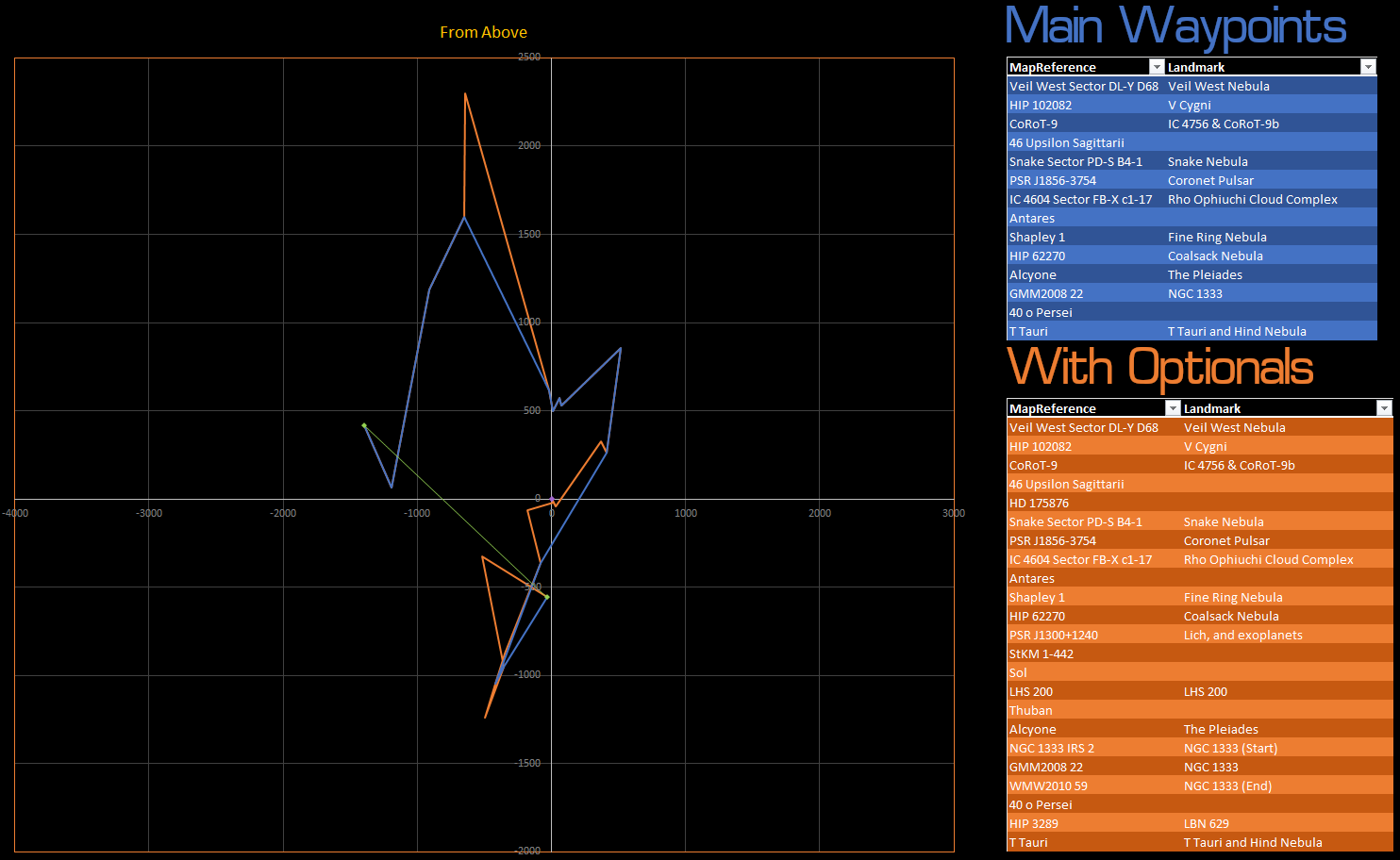
Map References quick reference list, more details below
HIP 102082
CoRoT-9
46 Upsilon Sagittarii
HD 175876
Snake Sector PD-S B4-1
PSR J1856-3754
IC 4604 Sector FB-X c1-17
Antares
Shapley 1
HIP 62270
PSR J1300+1240
StKM 1-442
Sol
LHS 200
Thuban
Alcyone
NGC 1333 IRS 2
GMM2008 22
WMW2010 59
40 o Persei
HIP 3289
T Tauri
Optional Waypoints Details
Map Reference: HD 175876
AKA: Heaven’s Lathe
The bright O-type star HD 175876 has a companion neutron-star with a surprising feature: Extremely large rings. The effective radius of the rings are 12 light seconds, and it has a mass of 5.16 x 10^17 kg – slightly greater than Thebe, a small moon of Jupiter. As the neutron star has a radius on the order of 10km, this object has an exceptionally large ring size relative to the central body. These massive metal-rich rings would provide enough material for hundreds of years for any colony.
Where the first extrasolar planets were discovered in 1992. It is a millisecond pulsar with a rotation period of a mere 6.22 milliseconds (9,650 rpm), but was found to have slight anomalies in its rotational period, leading to investigations as to the cause of that. Those investigation led to the confirmation of the first planets found outside of our own solar system. In 1994 an additional planet was also found in orbit of this pulsar.
Too far to be reachable by most ships, is an optional waypoint as a result
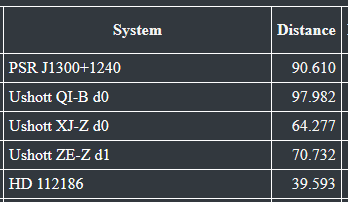
Route to: This route was found by CMDR Merlinsan during this expedition and has been edited into this post, start at HD 112186.
To get back out, can Neutron Boost back to Ushott ZP-X D1-0 and then two jumps to CG-X where 60+ Ly ships should be able to proceed normally from.
StKM 1-442 is a binary star in the Stephenson K & M stellar catalog which focuses on K and M class main sequence stars. However in-game it is not accuratley displayed as a binary system.
If you have exploration data to sell, this is a system belonging to our own Player Minor Faction, C.E.A. Psychiatric Institutions Ltd. and selling exploration data here could help boost our influence here so that we can expand to further systems.
First discovered in 450 BC by Anaxagoras, Sol is a G-class main sequence star of exactly 1 solar mass and 1 solar radii. It also hosts a mostly harmless Earth-like world “Earth” as its third planets, containing sentient lifeforms known as humans. (although their sentience is sometimes questionable)
What we mean by discovered in 450 BC by Anaxagoras is that this they were first to propose that our Sun may be a star like the other ones in the sky. It was later again suggested by Aristarchus of Samos, but did not catch on until later on still.
Other important first discoveries in this system:
Mercury, Venus, Mars, Jupiter, and Saturn: 2nd millenium BC by Babylonian astronomers. Used as evidence of the helicentric model by Aristarchus of Samos, and later in De Revolutionibus Orbium Coelestium by Nicolaus Copernicus
Ganymede, Callisto, Io, Europa: 7th and 8th January 1610 by Galileo Galilei
Titan: Christiaan Huygens, 13 June 1655
Iapetus and Rhea: Giovanni Domenico Cassini, 25 October 1671 & 23 December 1672 respectively
Tethys & Dione: Giovanni Domenico Cassini, 21 March 1684, published in Kosmotheôros
Uranus: William Herschel: March 13, 1781
Titania & Oberon: William Herschel, January 11, 1787
Enceladus & Mimas: William Herschel, August 28, 1789 & September 17, 1789 respectively
Neptune: Johann Gottfried Galle & Urbain Le Verrier on September 23, 1846
Thuban, also known as Alpha Draconis is a binary star system in the Draco constellation. Thuban was Earth’s north star between 4th and 2nd millenium BC instead of Polaris.
LBN 623 Nebula, also known as IC63, is a dark purple emission nebula. It has also been called the Gamma Cassiopeiae nebula due to visual proximity of that bright star and the nebula as seen from old Earth.